Sapphire Crystal: Why It's the Only Acceptable Choice for a Quality Watch
When you buy a watch, you look at the dial, the case, the strap. Rarely the crystal. Yet, it's what protects everything—and what makes the difference between a watch that ages well and one that deteriorates in a few months.
Mineral glass: the low-end standard
Mineral glass is classic tempered glass. It's found in the majority of watches sold for under €150. It has the advantage of being cheap to produce. Its drawback is that it scratches easily—with keys, a rough surface, an adjacent watch strap. After 18 months, the surface becomes dull and cloudy. The watch loses its luster.
Sapphire crystal: the choice for serious watches
Synthetic sapphire is the second hardest material known, after diamond. It ranks 9 on the Mohs scale—ordinary glass is at 5.5. In practice, only diamond can scratch it. Keys, metal, and everyday hard surfaces leave no trace.
The result: your watch remains as clear the day you receive it as it does five years later.
What A★Star chose—and why
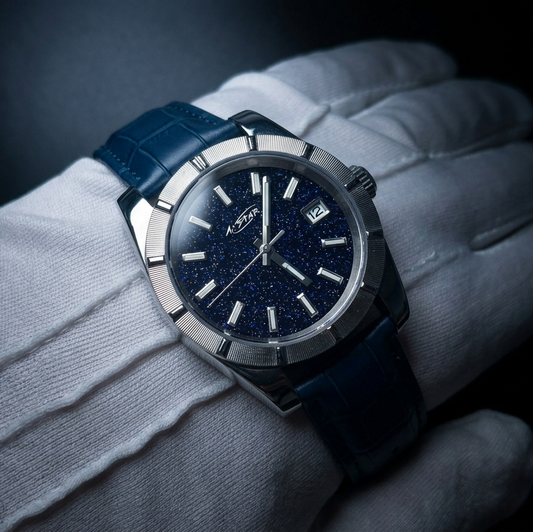
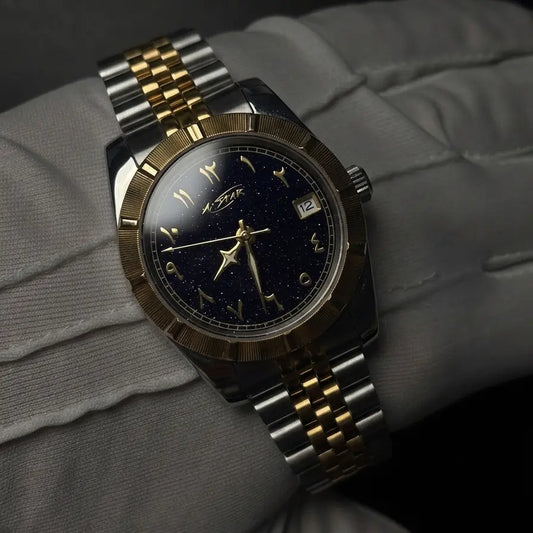
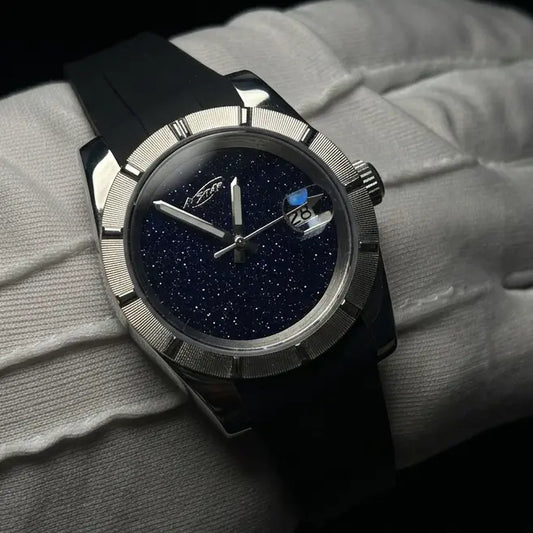
All our watches are equipped with a double-sided anti-reflective treated sapphire crystal. Double-sided, because the treatment is applied to both the inside AND outside of the crystal. This eliminates parasitic reflections in all lighting conditions—in bright sunlight, under artificial light, at night.
This choice costs more. But a watch worn every day deserves to withstand every day.
The transparent sapphire case back
The case back of our watches is also made of sapphire crystal. It allows a view of the NH35 movement in operation—the gears, the oscillating rotor, the mechanical architecture. For those who appreciate watchmaking mechanics, it's a spectacle in itself.