Double-sided sapphire crystal: why it's the best choice for a watch
When it comes to watch glass, three materials dominate the market: mineral glass, acrylic glass, and sapphire glass. At A★Star, we opted for double-sided sapphire. Here's why this choice changes everything.
The three types of watch glass
Acrylic glass
The cheapest of the three. It scratches easily but can be polished to remove superficial scratches. It is mainly found on entry-level watches.
Mineral glass
More resistant than acrylic, thermally treated to withstand everyday shocks. It is the standard for most mid-range watches. However, it can be scratched by hard materials.
Sapphire glass
The ultimate. Synthetic sapphire has a hardness of 9 on the Mohs scale — only diamond is harder. In practice, it is almost impossible to scratch under normal use conditions. This is the material used by major Swiss watchmaking houses for their luxury watches.
What is double-sided treatment?
Double-sided anti-reflective treatment involves applying multiple layers of anti-reflective coating to both surfaces of the glass — internal and external. The result: light passes through the glass without reflecting, offering perfect readability even in direct sunlight or under direct lighting.
Without this treatment, sapphire glass can paradoxically be more difficult to read than mineral glass, due to its reflections. Double-sided eliminates this problem.
Why A★Star chose double-sided sapphire
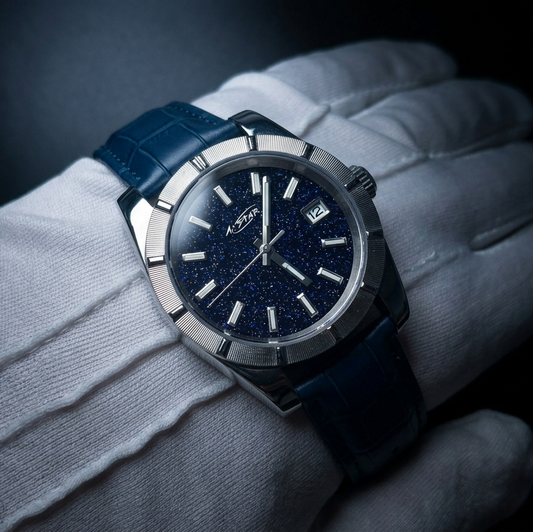
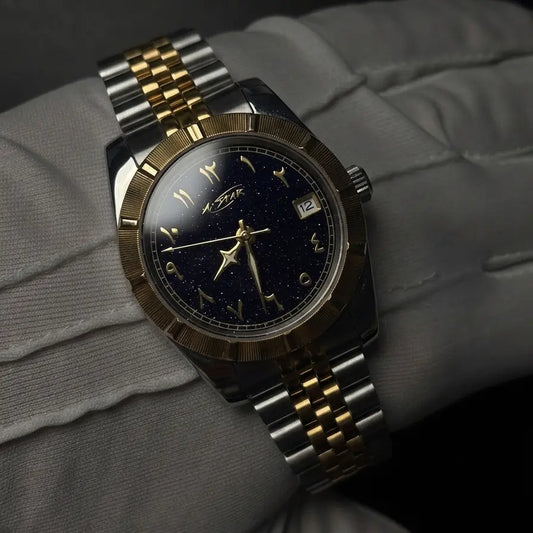
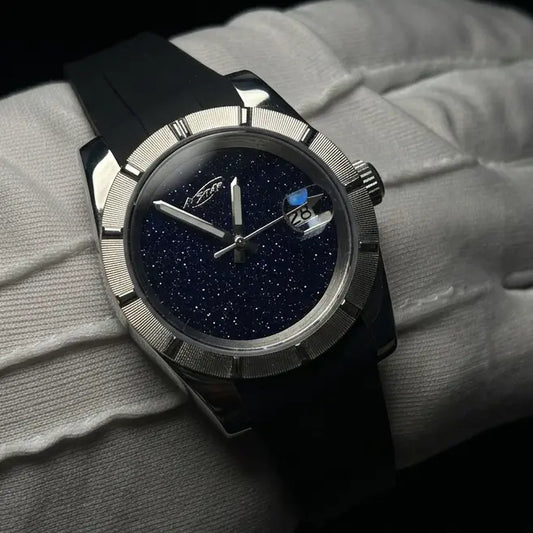
On a star-dial watch, the transparency of the glass is paramount. The aventurine dial deserves to be seen in all its depth, without parasitic reflections that would obscure the sparkle of the particles. Double-sided sapphire glass ensures you see your dial exactly as it is — at all times, in all lighting conditions.
It's a premium component typically found on watches selling for two to three times the price of ours. At A★Star, it's a standard.